
The trip, in order
Follow the route day by day. Times and prices can change, so check official information before you travel.
Bock and the old fortress
Luxembourg City
- 1
Bock Casemates
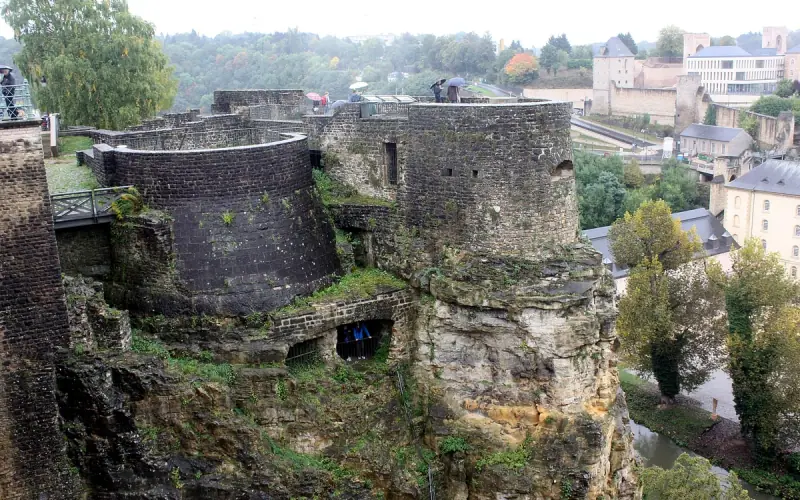
The Bock Casemates reveal the defensive logic behind Luxembourg City more clearly than an exterior viewpoint alone. Galleries cut into the rock open unexpectedly towards the Alzette valley, while surviving gun positions and passages show how the fortress used the natural escarpment as part of its defence. The visit also gives useful context for the old town above, the Grund below and the wider UNESCO-listed fortifications, making the site both an underground experience and a concise introduction to the capital’s military geography.
- Duration
- 90 minutes suggested
- Price
- Check current official information
- Start time
- Choose a start time that suits your day.
- 2
Chemin de la Corniche
The Chemin de la Corniche is one of the clearest ways to understand why Luxembourg became such a formidable fortress. The promenade follows the edge of the upper city, with the Alzette valley dropping sharply below and layers of walls, houses, bridges and church towers visible across the slopes. It is not simply a viewpoint: walking the route connects the Bock with the judicial and old-town areas while repeatedly revealing how civilian neighbourhoods grew around defensive terrain. The path is particularly useful for orientating the capital before exploring the Grund at river level.
- Duration
- 60 minutes suggested
- Price
- Check current official information
- Start time
- Choose a start time that suits your day.
- 3
Neimënster Abbey
Neimënster Abbey is valuable as much for its setting as for its architecture. The long former monastic buildings sit in the Grund directly below the old fortress, creating one of the clearest views of Luxembourg City’s stacked urban landscape. Inside and around the complex, changing exhibitions and cultural activity give a contemporary use to a site shaped by monastic, military and prison history. It works particularly well with the Bock and Corniche because the three locations explain the same valley from very different levels and historical perspectives.
- Duration
- 75 minutes suggested
- Price
- Check current official information
- Start time
- Choose a start time that suits your day.
Civic and religious centre
Luxembourg City
- 1
Grand Ducal Palace
The Grand Ducal Palace gives the capital’s political history a physical address within the old town rather than in a detached government quarter. Its Renaissance façade, guard presence and position among narrow central streets make the building easy to understand as both a historic civic structure and a working state residence. Even when interiors are unavailable, the exterior rewards a short architectural stop and fits naturally with nearby squares, the cathedral and the city museums, adding a living constitutional dimension to a walk through central Luxembourg.
- Duration
- 45 minutes suggested
- Price
- Check current official information
- Start time
- Choose a start time that suits your day.
- 2
Notre-Dame Cathedral
Notre-Dame Cathedral brings together several strands of Luxembourg’s religious and national history in one central building. The interior combines late Gothic visual language with later additions, while the crypt and memorial associations connect the church to the ruling dynasty and national ceremonies. Its position between the old town, government quarter and Constitution Square makes it easy to place within a wider city walk. The cathedral is also useful for understanding how a Jesuit foundation evolved into the principal Roman Catholic church of the Grand Duchy.
- Duration
- 60 minutes suggested
- Price
- Check current official information
- Start time
- Choose a start time that suits your day.
- 3
Lëtzebuerg City Museum
Lëtzebuerg City Museum focuses closely on how the capital grew, changed and lived with its unusual fortress landscape. Models, urban-history material and changing exhibitions provide context that can be difficult to reconstruct from individual monuments alone. The museum building is also part of the experience: old town houses are linked by contemporary architectural elements and vertical circulation across a steep site. It suits the beginning or end of a Luxembourg City stay because it ties together the Bock, valleys, bridges and civic institutions seen elsewhere on foot.
- Duration
- 90 minutes suggested
- Price
- Check current official information
- Start time
- Choose a start time that suits your day.
National collections and outer defences
Luxembourg City
- 1
National Museum of Archaeology, History and Art
The Nationalmusée is the most direct place to put Luxembourg’s long chronology into one visit. Archaeological material reaches back well before the modern state, while historical and artistic collections show how the territory developed within wider European political and cultural networks. The building itself mixes old-town fabric with modern museum spaces, so the route through the collections mirrors the layered city outside. It is especially useful after visiting castles or Roman sites elsewhere in the country because objects and interpretation provide a national framework for those individual places.
- Duration
- 120 minutes suggested
- Price
- Check current official information
- Start time
- Choose a start time that suits your day.
- 2
National Museum of Natural History
The natural-history museum adds an environmental dimension to a city otherwise dominated by fortress and political history. Displays on geology, habitats and species help explain the landscapes encountered later in the Ardennes, Müllerthal and Moselle wetlands, while broader natural-science material makes the museum suitable for mixed-interest groups. Its location in the Grund also means a visit can be combined with the Alzette riverside and Neimënster without returning to the upper city. The indoor setting provides a practical cultural stop when weather makes long outdoor visits less appealing.
- Duration
- 105 minutes suggested
- Price
- Check current official information
- Start time
- Choose a start time that suits your day.
- 3
Fort Thüngen
Fort Thüngen shows a different face of Luxembourg’s fortress heritage from the Bock. Instead of rock-cut galleries in the old town, the surviving work sits on the Kirchberg plateau and demonstrates how the defensive system extended across surrounding heights. The three reconstructed towers and earthworks are visually distinctive, while the adjacent museum and park setting help connect military history with the modern European quarter. A visit provides useful scale for understanding just how extensive the former fortress was before large sections were dismantled after 1867.
- Duration
- 60 minutes suggested
- Price
- Check current official information
- Start time
- Choose a start time that suits your day.
- 4
Adolphe Bridge
Adolphe Bridge is both a piece of engineering history and one of the most useful places for reading Luxembourg City’s topography. The main stone arch crosses the deep Pétrusse valley, explaining why bridges were so important to the city’s expansion beyond the old fortress. From nearby paths and viewpoints, the bridge can be seen against wooded slopes and the skyline of the upper town. Crossing it also links the historic centre with the railway-station side of the city, making the structure part of an ordinary urban walk rather than an isolated monument.
- Duration
- 35 minutes suggested
- Price
- Check current official information
- Start time
- Choose a start time that suits your day.