
The trip, in order
Follow the route day by day. Times and prices can change, so check official information before you travel.
Acropolis and Museum
Athens
- 1
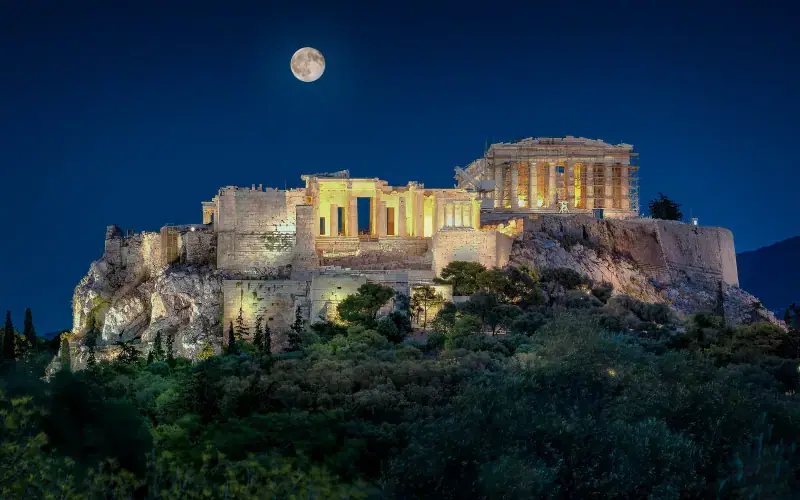
Acropolis of Athens
Classical sanctuary and citadel above Athens, centred on the Parthenon and other fifth-century BCE monuments. The rocky hill was fortified in prehistoric times, but its best-known monuments were created in the fifth century BCE under Pericles after the Persian destruction of 480 BCE. Later centuries brought Christian, Frankish and Ottoman uses before modern conservation. The visit is strongest when you focus on parthenon, erechtheion and caryatids and propylaea and panoramic city views.
- Duration
- 180 minutes suggested
- Price
- Admission is normally charged for the principal visitor area; check the current official rate.
- Start time
- Choose a start time that suits your day.
- 2
Acropolis Museum
Modern museum displaying sculpture and finds from the Acropolis in a building aligned with the ancient hill. The museum opened in 2009 to bring together surviving finds from the Acropolis and its slopes. Its galleries present material from the Archaic and Classical periods through Late Antiquity, with the Parthenon Gallery arranged around the temple's sculptural programme. The visit is strongest when you focus on parthenon gallery, archaic gallery and glass-floor views over excavations.
- Duration
- 150 minutes suggested
- Price
- Admission is normally charged for the principal visitor area; check the current official rate.
- Start time
- Choose a start time that suits your day.
Agora and National Collections
Athens
- 1
Ancient Agora of Athens
The civic and commercial heart of ancient Athens, with temples, public buildings and the reconstructed Stoa of Attalos. The Agora developed from the sixth century BCE as the centre of Athenian civic life. Assemblies, courts, markets and religious processions met here, and philosophers including Socrates moved through the public spaces; Roman and later phases reshaped parts of the site. The visit is strongest when you focus on temple of hephaestus, stoa of attalos and panathenaic way.
- Duration
- 120 minutes suggested
- Price
- Admission is normally charged for the principal visitor area; check the current official rate.
- Start time
- Choose a start time that suits your day.
- 2
National Archaeological Museum
Greece's major archaeological museum, covering prehistoric, Classical, Hellenistic, Roman and Egyptian collections. Founded in the nineteenth century and housed in its present neoclassical building from the late 1800s, the museum gathered major discoveries from excavations across Greece. Its collections include Mycenaean gold, monumental sculpture and the Antikythera mechanism. The visit is strongest when you focus on mask and grave goods from mycenae, antikythera mechanism and classical sculpture galleries.
- Duration
- 180 minutes suggested
- Price
- Admission is normally charged for the principal visitor area; check the current official rate.
- Start time
- Choose a start time that suits your day.
Cape Sounion
Athens
- 1
Temple of Poseidon at Cape Sounion
Fifth-century BCE seaside sanctuary dramatically positioned on the cliffs of Cape Sounion. The surviving marble temple was built around the mid-fifth century BCE on a strategic cape guarding sea approaches to Attica and the nearby Lavrion mining district. The sanctuary remained a landmark for sailors and later travellers approaching the Aegean coast. The visit is strongest when you focus on doric temple columns, aegean cliff views and fortification remains.
- Duration
- 90 minutes suggested
- Price
- Admission is normally charged for the principal visitor area; check the current official rate.
- Start time
- Choose a start time that suits your day.
Delphi
Delphi
- 1
Archaeological Site of Delphi
Pan-Hellenic sanctuary of Apollo on Mount Parnassus, home of antiquity's most influential Greek oracle. Delphi developed as a major religious centre by the Archaic period, where the Pythia delivered oracles consulted by cities and rulers across the Greek world. Treasuries, monuments and the Pythian Games reflected its international importance. The visit is strongest when you focus on temple of apollo, athenian treasury and ancient theatre and stadium.
- Duration
- 180 minutes suggested
- Price
- Admission is normally charged for the principal visitor area; check the current official rate.
- Start time
- Choose a start time that suits your day.
Meteora
Kalambaka
- 1
Meteora
Orthodox monasteries perched on towering sandstone pillars above Kalambaka and Kastraki. Hermits occupied caves in the rock formations by the medieval period, and organised monasteries developed especially from the fourteenth century. Twenty-four monasteries existed at the height of the community; six remain active and open at varying times. The visit is strongest when you focus on great meteoron, varlaam monastery and rock-pillar viewpoints.
- Duration
- 240 minutes suggested
- Price
- Admission is normally charged for the principal visitor area; check the current official rate.
- Start time
- Choose a start time that suits your day.
Thessaloniki Heritage
Thessaloniki
- 1
White Tower of Thessaloniki
Landmark Ottoman tower on Thessaloniki's waterfront, now housing an exhibition on the city's history. The present tower was built in the Ottoman period, probably in the fifteenth or sixteenth century, as part of the city's coastal defences. It later served as a prison and became the emblem of modern Thessaloniki after the waterfront walls were removed. The visit is strongest when you focus on city-history exhibition, spiral interior route and waterfront panorama.
- Duration
- 90 minutes suggested
- Price
- Admission is normally charged for the principal visitor area; check the current official rate.
- Start time
- Choose a start time that suits your day.
- 2
Rotunda and Galerius Complex
Late Roman imperial monuments in central Thessaloniki, including the Rotunda and nearby Arch of Galerius. The complex was created around the turn of the fourth century CE for Emperor Galerius. The Rotunda later became a Christian church, then a mosque under Ottoman rule, preserving important early Christian mosaics through these changes. The visit is strongest when you focus on rotunda mosaics, arch of galerius and roman palace remains.
- Duration
- 120 minutes suggested
- Price
- Admission is normally charged for the principal visitor area; check the current official rate.
- Start time
- Choose a start time that suits your day.
Aigai
Vergina
- 1
Archaeological Site of Aigai (Vergina)
Royal centre of ancient Macedon, famous for monumental tombs and rich grave goods linked to the dynasty of Philip II. Aigai was the first capital of the Macedonian kingdom. Its royal cemetery was used for centuries, and excavations in the twentieth century uncovered unplundered tombs beneath the Great Tumulus, transforming knowledge of ancient Macedonian court culture. The visit is strongest when you focus on royal tombs museum, great tumulus and palace remains.
- Duration
- 180 minutes suggested
- Price
- Admission is normally charged for the principal visitor area; check the current official rate.
- Start time
- Choose a start time that suits your day.
Mount Olympus
Litochoro
- 1
Mount Olympus National Park
Greece's highest mountain massif, combining deep gorges, forest, alpine terrain and demanding routes toward the summit zone. Olympus has held mythic importance since antiquity as the home of the Olympian gods. Greece declared it its first national park in 1938, protecting ecosystems that rise from Mediterranean woodland to high alpine habitats. The visit is strongest when you focus on enipeas gorge, prionia trailhead and high-mountain refuges and summit routes.
- Duration
- 360 minutes suggested
- Price
- Mostly free public access; particular museums, organised activities, parking or managed areas may charge.
- Start time
- Choose a start time that suits your day.
Mycenae
Nafplio
- 1
Archaeological Site of Mycenae
Bronze Age citadel of the Mycenaean world, famous for the Lion Gate, royal graves and massive Cyclopean walls. Mycenae flourished especially from the sixteenth to twelfth centuries BCE and became one of the principal centres of Late Bronze Age Greece. Excavations revealed shaft graves, palace remains and rich objects that shaped the modern understanding of Mycenaean civilisation. The visit is strongest when you focus on lion gate, grave circle a and treasury of atreus.
- Duration
- 150 minutes suggested
- Price
- Admission is normally charged for the principal visitor area; check the current official rate.
- Start time
- Choose a start time that suits your day.
Epidaurus and Palamidi
Nafplio
- 1
Sanctuary of Asklepios at Epidaurus
Ancient healing sanctuary renowned for its exceptionally preserved theatre and sacred buildings. Epidaurus became a major sanctuary of Asklepios, god of healing, from the Classical period onward. Pilgrims came for ritual and treatment, while the theatre, built in the fourth century BCE and later enlarged, served festivals connected with the cult. The visit is strongest when you focus on ancient theatre, temple and healing complex and stadium.
- Duration
- 150 minutes suggested
- Price
- Admission is normally charged for the principal visitor area; check the current official rate.
- Start time
- Choose a start time that suits your day.
- 2
Palamidi Fortress
Vast Venetian fortress above Nafplio, with bastions, walls and commanding views over the Argolic Gulf. The Venetians built Palamidi in the early eighteenth century during their final period of rule in the Peloponnese. It soon passed to the Ottomans and later played a decisive role in the Greek War of Independence when Greek forces captured it in 1822. The visit is strongest when you focus on venetian bastions, views over nafplio and historic prison spaces.
- Duration
- 120 minutes suggested
- Price
- Admission is normally charged for the principal visitor area; check the current official rate.
- Start time
- Choose a start time that suits your day.
Mystras
Sparta
- 1
Archaeological Site of Mystras
Ruined Byzantine city climbing a steep hillside above Sparta, with palaces, churches, monasteries and fortifications. Mystras was founded as a Frankish stronghold in the thirteenth century and soon became a major Byzantine centre of the Despotate of the Morea. It flourished in the fourteenth and fifteenth centuries before Ottoman conquest and gradual decline. The visit is strongest when you focus on palace of the despots, pantanassa monastery and frescoed churches and castle.
- Duration
- 180 minutes suggested
- Price
- Admission is normally charged for the principal visitor area; check the current official rate.
- Start time
- Choose a start time that suits your day.
Monemvasia
Monemvasia
- 1
Monemvasia
Medieval fortified town on a dramatic rock linked to the Peloponnese by a causeway. Founded in the sixth century by communities seeking refuge from invasions, Monemvasia became an important Byzantine trading and military centre. Frankish, Venetian and Ottoman rulers later shaped the lower town, churches and fortifications. The visit is strongest when you focus on lower town lanes, church of christ elkomenos and upper town and sea views.
- Duration
- 180 minutes suggested
- Price
- Mostly free public access; particular museums, organised activities, parking or managed areas may charge.
- Start time
- Choose a start time that suits your day.
Ancient Olympia
Olympia
- 1
Archaeological Site of Olympia
Sanctuary of Zeus where the ancient Olympic Games were held, with stadium, temples and major museum collections. Olympia became the principal sanctuary of Zeus in the western Peloponnese and hosted the Olympic Games traditionally dated from 776 BCE. Monumental buildings accumulated over centuries before the games ended in Late Antiquity. The visit is strongest when you focus on ancient stadium, temple of zeus and archaeological museum of olympia.
- Duration
- 180 minutes suggested
- Price
- Admission is normally charged for the principal visitor area; check the current official rate.
- Start time
- Choose a start time that suits your day.
Corinth and Acrocorinth
Corinth
- 1
Ancient Corinth
Extensive ancient city beneath Acrocorinth, with the Temple of Apollo, Roman forum and archaeological museum. Corinth prospered through control of the Isthmus and maritime trade. Destroyed by Rome in 146 BCE, it was refounded as a Roman colony in 44 BCE and became an important provincial capital; the apostle Paul also lived and preached here. The visit is strongest when you focus on temple of apollo, roman forum and peirene fountain.
- Duration
- 120 minutes suggested
- Price
- Admission is normally charged for the principal visitor area; check the current official rate.
- Start time
- Choose a start time that suits your day.
- 2
Acrocorinth
Massive fortified hill above ancient Corinth with walls and gateways from successive Greek, Byzantine, Frankish, Venetian and Ottoman periods. The strategic rock was fortified in antiquity and repeatedly strengthened by later rulers controlling the Isthmus. Byzantine, Frankish, Venetian and Ottoman phases created the layered defensive complex visible today. The visit is strongest when you focus on triple gateway, long defensive walls and panoramic isthmus views.
- Duration
- 120 minutes suggested
- Price
- Mostly free public access; particular museums, organised activities, parking or managed areas may charge.
- Start time
- Choose a start time that suits your day.