
The trip, in order
Follow the route day by day. Times and prices can change, so check official information before you travel.
Tsarevets and Arbanasi
Veliko Tarnovo
- 1
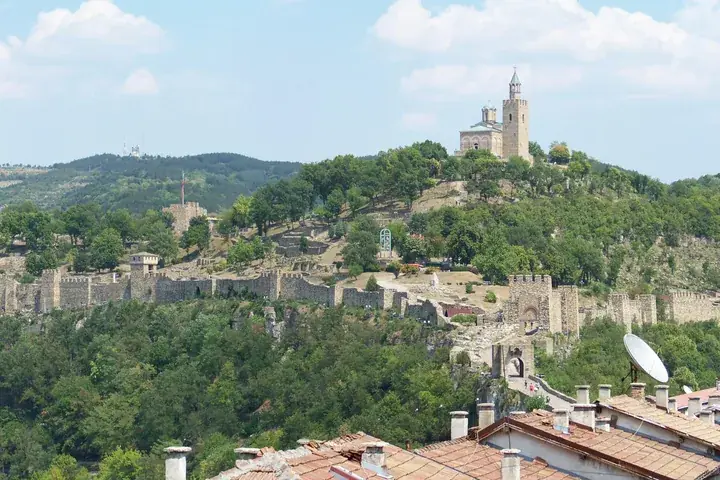
Tsarevets Fortress
Tsarevets turns the history of the Second Bulgarian Empire into a readable urban and defensive landscape. The hilltop walls, palace remains and patriarchal complex show how political and religious institutions were concentrated within a fortified capital. Walking the site also reveals why Tarnovo was difficult to approach, with steep slopes and the Yantra shaping its defences. The views connect the medieval citadel with the modern city and neighbouring historic quarters.
- Duration
- 120 minutes suggested
- Price
- Check the current official visitor information before travel.
- Start time
- Choose a start time that suits your day.
- 2
Arbanasi Architectural Reserve
Arbanasi provides a social and architectural contrast to nearby Tsarevets. Instead of royal and military remains, the village preserves the houses and churches of prosperous merchants living under Ottoman rule. Thick walls, concealed courtyards and richly decorated interiors reveal both wealth and concern for security. The short distance from Veliko Tarnovo makes the contrast especially useful for understanding how the region changed after the medieval capital lost its political role.
- Duration
- 120 minutes suggested
- Price
- Check the current official visitor information before travel.
- Start time
- Choose a start time that suits your day.
Etar Craft Heritage
Gabrovo
- 1
Etar Architectural-Ethnographic Complex
Etar is particularly effective because craft history is shown through working spaces rather than only display cases. Water channels, workshops and tools demonstrate how local production depended on the mountain environment, while houses and streets give the crafts a broader social setting. The museum complements preserved towns such as Tryavna and Bozhentsi by explaining the practical skills and technologies that supported their economies during the National Revival.
- Duration
- 120 minutes suggested
- Price
- Check the current official visitor information before travel.
- Start time
- Choose a start time that suits your day.
Bozhentsi and Tryavna
Tryavna
- 1
Bozhentsi Architectural-Historical Reserve
Bozhentsi is valuable as a whole village landscape rather than for one dominant monument. The size and spacing of houses, their heavy stone roofs and the narrow lanes show how a prosperous Balkan community fitted into a confined wooded valley. Compared with museum reconstructions, the reserve preserves the logic of a real settlement. It also provides a quieter architectural link between Gabrovo’s craft heritage and the urban traditions of nearby Tryavna.
- Duration
- 120 minutes suggested
- Price
- Check the current official visitor information before travel.
- Start time
- Choose a start time that suits your day.
- 2
Tryavna Museum of Wood-Carving and Ethnographical Arts
The museum explains why Tryavna’s built heritage is more than attractive façades. Carved ceilings, icons, tools and workshops reveal a specialised artistic economy that supplied churches and homes across Bulgaria. Seeing these objects in the houses where craftspeople and patrons lived makes the connection between skill, status and architecture clearer. The collections also help visitors recognise similar carving and painting traditions later encountered in monasteries, churches and Revival houses elsewhere in the country.
- Duration
- 90 minutes suggested
- Price
- Check the current official visitor information before travel.
- Start time
- Choose a start time that suits your day.
Dryanovo Monastery and Bacho Kiro Cave
Dryanovo
- 1
Dryanovo Monastery
Dryanovo Monastery combines religious heritage with revolutionary history and a strong natural setting. The complex is visually modest compared with Rila or Bachkovo, but its location in a narrow gorge and its role in the April Uprising give it a distinct character. The nearby cave adds prehistoric and geological context, allowing one stop to connect monastic life, 19th-century conflict and the karst landscape of the central Balkan foothills.
- Duration
- 90 minutes suggested
- Price
- Check the current official visitor information before travel.
- Start time
- Choose a start time that suits your day.
- 2
Bacho Kiro Cave
Bacho Kiro Cave is unusual because its archaeological importance is as significant as its geology. The underground passages show the karst processes that shaped the Dryanovo gorge, while excavated remains connect the same space with very early human activity. Visiting the cave beside the monastery creates a particularly wide historical sequence within a small area, from prehistoric occupation through medieval religious life to the revolutionary events of the 19th century.
- Duration
- 90 minutes suggested
- Price
- Check the current official visitor information before travel.
- Start time
- Choose a start time that suits your day.